NeutralAI Blog
Practical notes for secure enterprise AI adoption.
Guides on PII masking, AI governance, browser-based AI risk, and the controls regulated teams need before broad rollout.
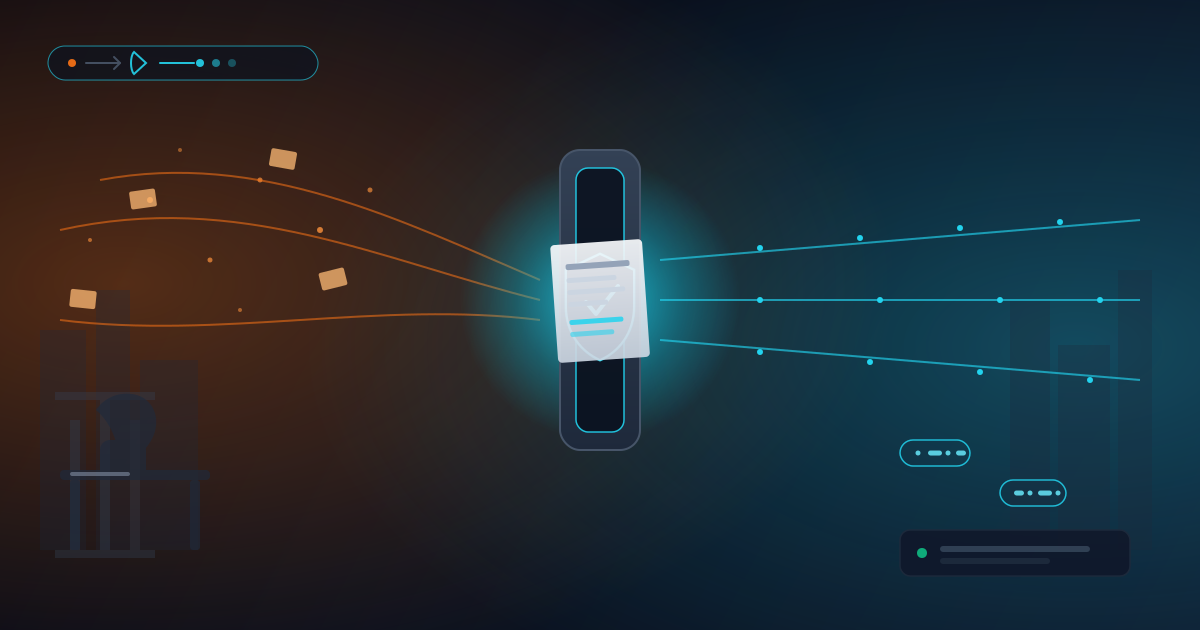
A UK Tribunal Treated Pasting Client Letters Into ChatGPT as a Data Breach
An Upper Tribunal ruling on an immigration adviser's ChatGPT use shows the real lesson is controls and evidence, not banning AI. Here's what actually failed.
Latest Articles
Start with the controls that unblock AI.
A UK Tribunal Treated Pasting Client Letters Into ChatGPT as a Data Breach
An Upper Tribunal ruling on an immigration adviser's ChatGPT use shows the real lesson is controls and evidence, not banning AI. Here's what actually failed.

The half-token that leaks the data you just hid
How we re-insert masked values into a streaming LLM response without ever leaking a half-token, and the one rule that fixes it.

Why our PII filter loads a transformer the moment it sees the letter 'ş'
spaCy has no Turkish model and the English one mis-bounds Turkish names. How a single character triggers a transformer for multilingual PERSON detection.

Catching sensitive data is the easy part. Not catching everything else is the job.
The hard part of PII detection is not finding the data, it is rejecting everything that merely looks like it: checksums, context gates, overlap suppression.

Reversible masking is a honeypot waiting to happen. Here's how we defused it.
Reversible PII masking needs a token-to-value store, which is a honeypot waiting to happen. How a TTL, AES-256-GCM, and AEAD context-binding defuse it.

You tightened a security rule. Most of your servers never heard about it.
Cache a policy in memory, run several replicas, and a rule you changed on one server runs stale on the others. How pub/sub, polling, and signatures keep them consistent.

An audit log you can edit proves nothing
An audit log you can edit proves nothing. How per-entry hashing, signatures, a hash chain, and S3 Object Lock make a tamper-evident ledger.

A security gateway shows its real character on the day things break
A security gateway's real character shows on the bad day. Backpressure, a circuit breaker, and graceful drain, so every failure lands on the safe side.

We hand-wrote our JWT verifier, because in JWT, flexibility is a vulnerability
JWT's most famous bugs come from library flexibility, not the crypto. Why pinning one algorithm in ninety lines removes the alg-confusion class entirely.

Some secrets have no pattern: we catch them by meaning, not regex
Some sensitive content has no pattern. Catching it by meaning with embeddings, and keeping a fuzzy ML signal under control in production.

Rotating a key is easy; rotating it without breaking your old data is not
Rotating a key without breaking every value it ever encrypted or signed. A versioned keyring that turns rotation into adding a row, not a migration.

The most dangerous misconfiguration is the one that boots cleanly
The most dangerous misconfiguration is the one that boots cleanly. Refusing to start in production when a secret is missing or still a placeholder.

A customer hands you their most sensitive key: how do you hold it?
When a customer hands you their LLM key, you become its custodian. Per-tenant derived keys, AEAD context-binding, and rotation that locks no one out.

Billing is the last place you can afford to be sloppy
Billing can't lose an event or count one twice. A transactional outbox with idempotency, single-worker claiming, backoff, and a dead-letter.

Scanning a message is easy; scanning a 50-page PDF is a different job
Scanning a chat message is easy; scanning a 50-page PDF is not. Safe extraction, zip-bomb limits, chunking with page provenance, and scoped storage.

One API that says 'send to the model': four separate decisions behind it
Behind one send-to-the-model API hide four decisions. A pluggable routing strategy, one provider abstraction, and per-provider resilience.

From Presidio to Production: What Regulated Teams Actually Need
Presidio is a useful PII detection foundation, but regulated AI workflows need policy, routing, tokenization, and audit evidence around detection.

The Hidden Cost of Shadow AI: Why Security Teams Need a Control Point
Shadow AI is not only a policy problem. It creates review cost, incident uncertainty, and adoption drag unless teams add a visible control point.

How UK Financial Services Teams Use AI Safely Under FCA Guidance
A practical AI governance pattern for UK financial services teams adopting LLMs while protecting customer data and sensitive records.

NeutralAI vs Private AI vs Nightfall: PII Detection Benchmark 2026
A sales-safe comparison of public PII detection evidence, benchmark claims, and the questions buyers should ask before trusting vendor accuracy numbers.

PII Detection Accuracy: Regex vs NER vs LLM-Based Approaches
A technical comparison of regex, named entity recognition, and LLM-based PII detection for teams protecting prompts before model routing.
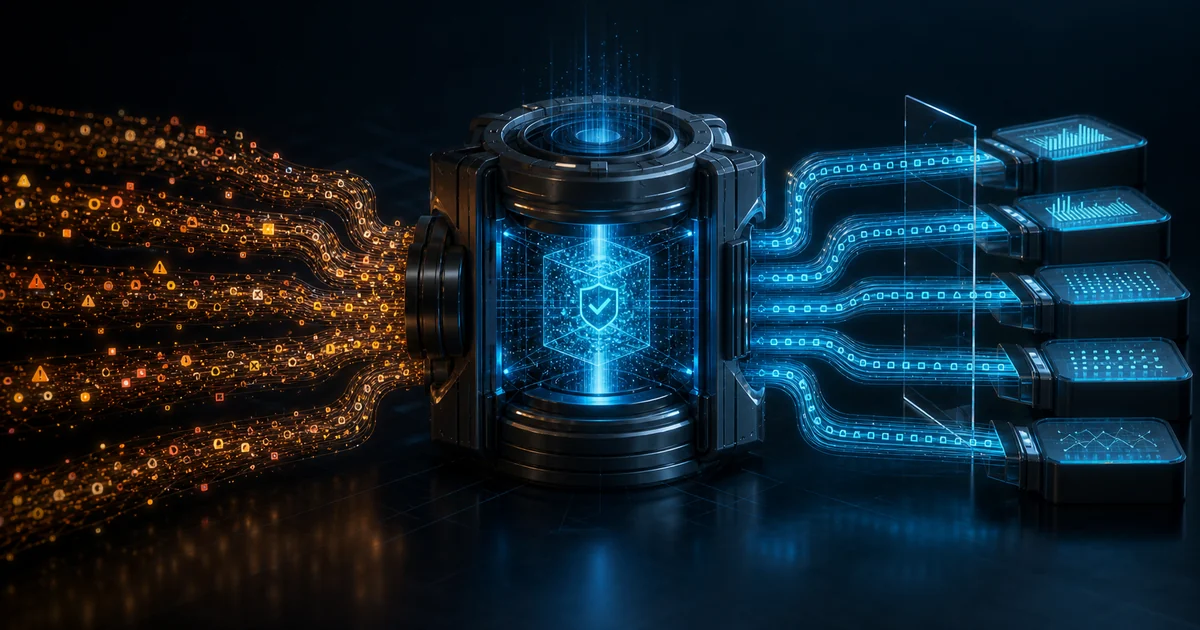
A customer's security team wants your logs, but not a single email can be in them
A customer's SOC wants your events, but not a single email can leak. Normalizing to one canonical, PII-free event and translating it per SIEM.

Why PII Masking Matters for Enterprise AI Adoption
A practical guide to why regulated teams need PII masking before prompts reach external AI providers.

Your logs are a back door for PII
Your logs are a back door for PII. Why redaction belongs in the logging pipeline itself, scanning even the logs you did not write.

Sending a webhook means letting a customer point your server at any address they like
An outbound webhook is two dangers at once: SSRF on a customer-controlled URL, and proving the payload is really from you. Signing, IP-blocking, DNS pinning.